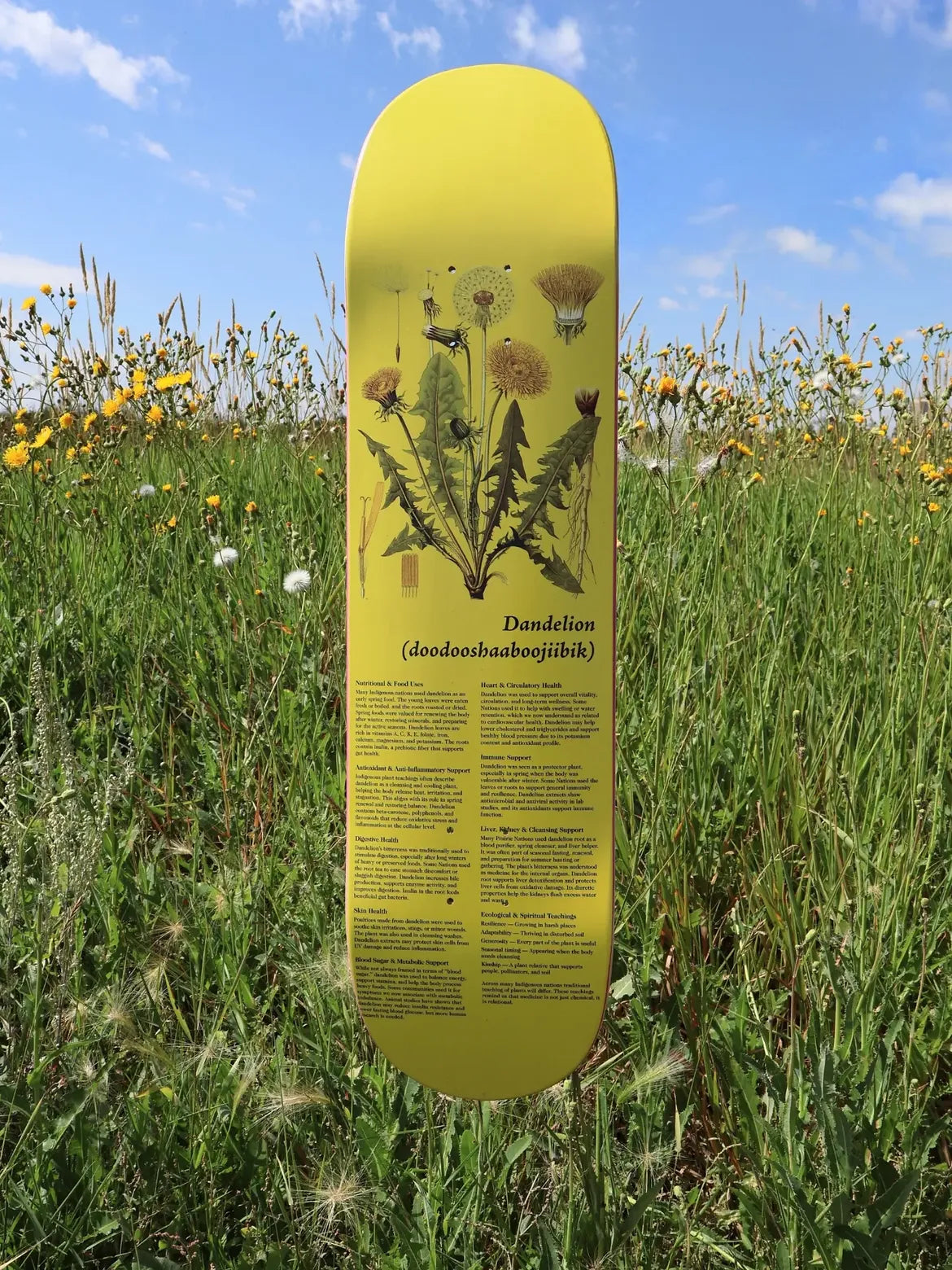
Colonialism Indigenous Medicine Plant Series Deck - 8.25 Dandelion
Colonialism Indigenous Medicine Plant Series Deck - 8.25 Dandelion
DESCRIPTION
DESCRIPTION
Griptape is not included in the price of our decks. If you need to add some, please visit the griptape section of our website: https://ninetimesskateshop.com/collections/grip
From www.colonialism.ca
For the next graphic, Colonialism looks at the history surrounding Indigenous Plants and their health benefits. This series is part of our ongoing work to decolonize the way we think about plants, medicine, and our relationship with the land.
Since time immemorial, Indigenous peoples across Turtle Island have relied on our plant relatives for nourishment, healing, ceremony, and teachings. Medicine men and women in communities understood where to gather each plant, how to prepare it, and the specific season in which its healing properties were strongest. This traditional knowledge is relational and rooted in land based science, passed down through generations.
Western frameworks often label plants such as dandelion, stinging nettle, and common thistle as “weeds” or “invasive.” However, Indigenous knowledge systems recognize these plants as powerful medicines with physical, emotional, and spiritual significance. The Indigenous Plant Series challenges colonial narratives by honouring these plant relatives and the powerful teachings they carry.
The Indigenous Plant Series brings land-based knowledge into everyday spaces. By placing plant relatives on skateboard decks, Colonialism Skateboards honours the knowledge keepers who protected these medicines and challenges colonial mindsets that devalue Indigenous science. These boards celebrate the continuity of Indigenous plant knowledge and the relationship between land, culture, and community.
This board series is in honour of the time I spent with my students at Piapot First Nations. Throughout the year, we learned and explored traditional plants in their community. We had conversations, invited Knowledge Keepers into the class, and made artwork in different mediums. I wanted them to learn this knowledge and continue seeking the teachings that exist within their community.
Traditional Protocols: When seeking guidance about plant medicines, it is important to follow cultural protocols:
• All Indigenous communities have different protocols, so it’s best to ask questions regarding their traditional protocols and respect them.
• Bring tobacco when asking a Knowledge Keeper or Elder for help, teachings, or clarification.
• Offer tobacco respectfully, acknowledging that plant medicines come with responsibilities.
• Follow any instructions or protocols - like tobacco offerings when picking medicines - shared by the Knowledge Keeper, as teachings vary between Nations and families.
• Always approach traditional medicine with humility, gratitude, and respect.
Warnings and Safety Notes
• These boards share cultural teachings and are for educational purposes.
• Identify plants with certainty; some have harmful look alikes.
• Avoid harvesting near roads, ditches, or areas treated with pesticides or herbicides.
• Do not gather plants exposed to lawn chemicals, spray drift, or industrial runoff.
• Stinging nettle may cause skin irritation or allergic reactions.
• Some people may be sensitive or allergic to plants like thistle or nettle.
• The 100% Rule: Never consume any wild plant unless you have cross-referenced it across multiple sources and are completely certain of its identity.
• Consult a healthcare professional if you have medical conditions, are pregnant, breastfeeding, or taking medications.
References
Chevallier, A. (2016). Encyclopedia of herbal medicine (3rd ed.). DK Publishing.
Foster, S., & Duke, J. A. (2014). A field guide to medicinal plants and herbs of North America (2nd ed.). Houghton Mifflin Harcourt.
Garrett, J. T. (2003). The Cherokee herbal: Native plant medicine from the Four Directions. Bear & Company.
Garrett, J. T. (2006). The Cherokee medicine book: Herbs, rituals, and remedies for healing. Bear & Company.
Geniusz, M. S. (2009). Our knowledge is not primitive: Decolonizing botanical Anishinaabe teachings. Syracuse University Press.
Geniusz, M. S. (2015). Plants have so much to give us, all we have to do is ask: Anishinaabe botanical teachings. University of Minnesota Press.
Kimmerer, R. W. (2013). Braiding sweetgrass: Indigenous wisdom, scientific knowledge, and the teachings of plants. Milkweed Editions.
MacKinnon, A., Kershaw, L., & Arnason, J. (2009). Edible and medicinal plants of Canada. Lone Pine Publishing.
Marles, R. J., Clavelle, C., Monteleone, L., Tays, N., & Burns, D. (2000). Aboriginal plant use in Canada’s northwest boreal forest. Natural Resources Canada.
Moerman, D. E. (1998). Native American ethnobotany. Timber Press.
Turner, N. J. (2005). The Earth’s blanket: Traditional teachings for sustainable living. Douglas & McIntyre.